Meerkats are among the best-known desert mammals, yet their success is not based on strength or speed alone. Their survival depends on cooperation, constant vigilance, and a highly organized social structure that allows them to thrive in one of the world’s harshest environments.
Life in the desert demands remarkable adaptations, and meerkats have evolved an impressive combination of social behavior and survival strategies. Living in an extremely arid region with high temperatures and limited water, these small carnivorous mammals rely on cooperation rather than individual strength to overcome daily challenges.
Although only around 30 centimeters long, meerkats have developed complex communities where every member contributes to the group’s success. Their behavior has made them one of the most recognizable desert animals featured in wildlife documentaries.
Living Together in a Harsh Desert Environment
Meerkats inhabit a vast desert ecosystem regarded as one of the most demanding environments on Earth. Water is scarce, temperatures can be extreme, and food is not always easy to find.
However, during the short rainy season, the landscape briefly transforms, providing resources that support local wildlife. Because of the ecological importance of this fragile habitat, a large protected natural area has been established to help preserve its biodiversity.
A Social Structure Built on Cooperation
One of the most remarkable characteristics of meerkats is their highly organized social system.
They live in small colonies and construct deep underground burrows connected through an extensive network of tunnels. Within each group, a dominant female is responsible for reproduction. After a gestation period of approximately eleven weeks, she gives birth to one or two pups.
The care of the young, however, is shared among the females in the colony. This cooperative approach increases the chances of survival for the offspring while strengthening the group as a whole.
Sentinels: The Secret Behind Meerkat Survival
Perhaps the best-known feature of meerkat behavior is their sentinel system.
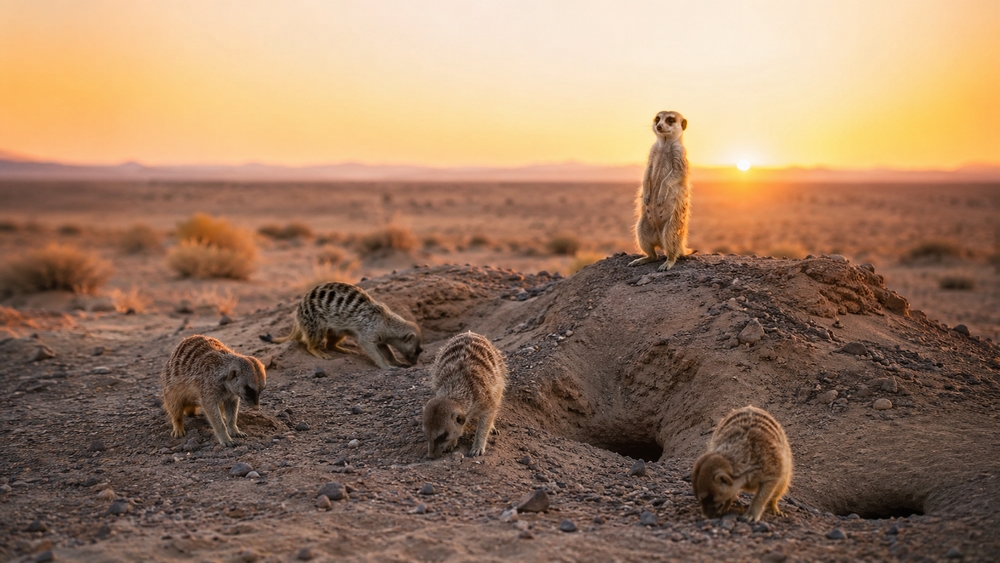
Throughout the day, one or two individuals take turns standing upright on elevated positions while carefully scanning the surrounding landscape. If danger approaches, they immediately produce an alarm call that sends the entire colony rushing back into the safety of its burrows.
Moreover, if a predator successfully attacks because of a momentary lapse in attention, the colony temporarily increases the number of sentinels. Consequently, the overall level of vigilance rises until the group once again feels secure.
Meanwhile, the animals continue their daily routine of digging for insects, hunting small rodents and reptiles, playing, and maintaining their underground homes.
Why Meerkats Continue to Fascinate Scientists and Nature Lovers
The survival of a meerkat colony depends on collaboration.
Even when an individual is lost, the remaining members continue performing their roles to ensure the continuity of the group. Furthermore, the instinct to act as a sentinel remains deeply rooted, even in animals raised in captivity.
Therefore, the ability to detect threats quickly and communicate danger efficiently represents one of the most successful behavioral adaptations developed for life in the desert.

What To Know In Brief
- Meerkats live in one of the world’s harshest desert environments.
- They build extensive underground tunnel systems.
- Colonies rely on cooperative care of their young.
- Sentinel behavior protects the group from predators.
- Teamwork is the key to the colony’s long-term survival.
FAQ
Meerkats are small carnivorous desert mammals known for their cooperative social behavior and sentinel system.
They inhabit large desert regions characterized by extreme temperatures and limited water availability.
Their diet mainly consists of insects, small rodents, and reptiles.
They act as sentinels, watching for predators and warning the colony of potential danger.
Shared responsibilities—including raising young and guarding the colony—improve the survival of the entire group.
Conclusion
Meerkats demonstrate how cooperation can become the most effective survival strategy in an unforgiving environment. Their organized social life, shared responsibilities, and constant vigilance allow these small desert mammals to overcome challenges that would be difficult for solitary animals. Their remarkable behavior continues to attract the attention of researchers, wildlife enthusiasts, and documentary filmmakers alike.