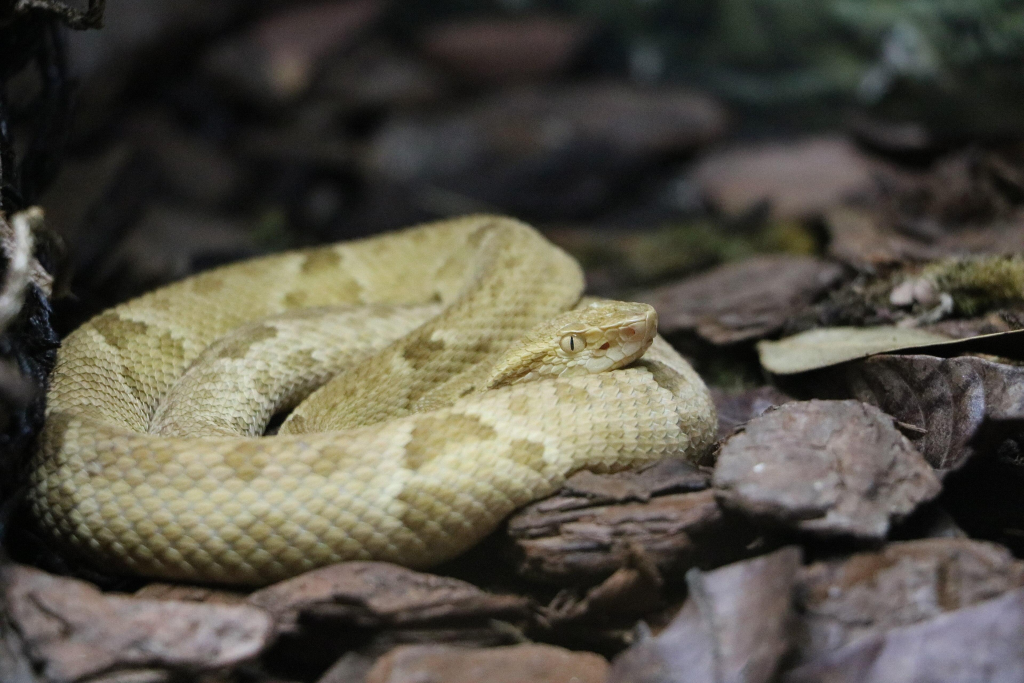
The golden lancehead is one of the rarest snakes in the world. It lives only on Queimada Grande Island, a small island off the coast of Brazil. This snake is famous for its bright yellow color, powerful venom, and extreme isolation. It is also a serious conservation concern because its entire wild population depends on one tiny place. Here is a simple, fact-based look at what makes the golden lancehead so unusual.
Golden Lancehead: What It Is and Where It Lives
The golden lancehead, Bothrops insularis, is a venomous pit viper. It is found only on Queimada Grande Island, also known as Snake Island, off the coast of São Paulo, Brazil. That narrow range is one of the main reasons the species gets so much attention. A snake that lives in only one place is always more vulnerable than a species spread across many habitats.
Its name comes from two clear traits. The snake has a golden or yellowish body, and its head has the lance-like shape common to the genus Bothrops. The result is a snake that is both visually striking and biologically specialized. For many readers, this is the key fact to remember: the golden lancehead is not just rare. It is island-endemic, meaning it exists naturally in only one wild location.
Why the Golden Lancehead Is So Rare
The species became isolated when sea levels rose and separated the island from the mainland thousands of years ago. Over time, that isolation shaped its evolution. Without the same mix of predators and prey found on the mainland, the snake adapted in a very different way. It is now part of a small, isolated ecosystem that is hard to reach and hard to study.
Some reports estimate that the island holds between 2,000 and 4,000 golden lanceheads, with very high density in some areas. Even with that number, the species is still considered highly vulnerable because all of those snakes depend on one small island. If that habitat is damaged, the whole wild population is at risk.
Access to the island is tightly controlled. That is not a tourism choice. It is a safety and conservation measure. The island is dangerous for people, and it is also a fragile place for the snake itself.
Venom, Diet, and Survival
The golden lancehead is known for its strong venom. In plain terms, this venom helps the snake catch prey fast. It is especially useful because the snake feeds partly on birds, including migratory birds that pass through the island. A fast-acting venom is a practical survival tool in that setting.
This is one reason the species has drawn scientific interest. Researchers study its venom not only because it is dangerous, but also because snake venom can contain compounds that may help in medical research. The snake is a conservation story first, but it is also a case study in adaptation.
The biggest issue is simple: rarity makes the species fragile. A local fire, disease, habitat damage, or illegal collecting could harm a population that already has no backup wild home. That is why the golden lancehead is widely described as critically endangered.
What To Know In Brief
- The golden lancehead is a venomous pit viper found only on Queimada Grande Island.
- It is widely described as critically endangered.
- Its diet includes birds, especially migratory birds.
- The island is tightly controlled and not open to normal tourism.
- The species matters for both conservation and venom research.
Related Reading
- Smithsonian Magazine on Snake Island and the golden lancehead.
- The Reptile Database entry for Bothrops insularis.
FAQ
The golden lancehead is a venomous pit viper, scientifically named Bothrops insularis. It lives only on Queimada Grande Island in Brazil.
It is rare because it has an extremely small natural range. All known wild individuals depend on one isolated island.
Yes. It is a venomous snake, and its bite is considered medically serious. Sources describe its venom as very powerful and fast acting.
Its diet includes birds, especially migratory birds that visit the island.
No normal tourism is allowed. Access is tightly controlled for safety and conservation reasons.
Conclusion
The golden lancehead is a rare snake shaped by isolation. Its bright color, island home, strong venom, and limited range make it one of the most unusual reptiles in the world. Its future depends on protecting a very small habitat and the balance of a very small ecosystem. In the years ahead, the species will likely remain a major focus for conservation work and venom research.