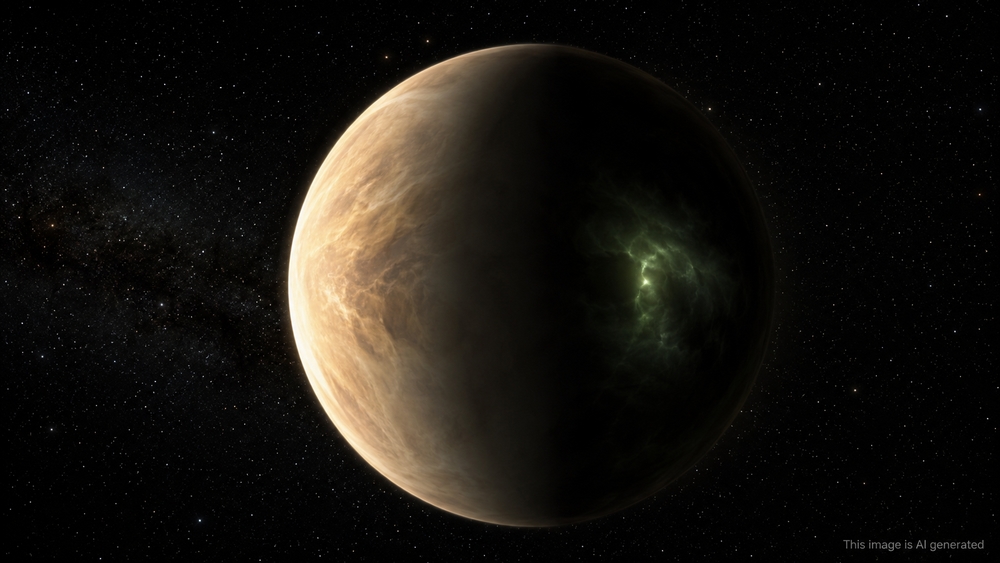
The strange Ashen Light of Venus has caught the attention of scientists for hundreds of years. Seen with the eyes this soft shine shows up on the part of the planet that is not lit up and still confuses scientists. Many ideas have been suggested over time. None has completely explained the puzzle. With the information that is there the event is still being studied by scientists.
The glow of Venus is one of the talked about things, in the field of studying planets. It refers to a faint light seen on the part of Venus that is not facing the Sun directly. People have noticed this thing times since it was first written about hundreds of years ago.. Scientists still don’t have a clear answer. Also the light is so weak. Comes and goes so often that it is very hard to prove it scientifically.
Why Is the Ashen Light So Difficult to Study?
One of the challenges is that the phenomenon has only been seen with the eyes. Neither machines on the ground nor machines, in space have captured it directly. Because of this scientists have not been able to get measurements that can prove where it comes from.
Also the glow is faint not steady and hard to make the way every time. This makes it very hard to study in a way.
Competing Explanations for the Mysterious Glow
The Ashen Light has had a lot of ideas about what it is.
Some people think the Ashen Light is something that happens in our minds because of how we see things or what we expect to see.
The Ashen Light might look like it is there because of the way light moves around or because of problems with the tools we use to look at it. Because the sky is bright or because of things in the air.
But since a lot of people have said they saw the Ashen Light and they are trustworthy scientists have tried to figure out if there is a reason for it.
The Ashen Light could be light that bounces off something in space or it could be like the northern lights or it could be electricity in the air or it could be heat that we cannot see that comes from the air, around the planet.
The Ashen Light has been looked at. Most of these ideas do not seem to be true.
A Promising Scientific Hypothesis
The other ideas that are left one of them is really getting a lot of attention.
Researchers think that tiny particles from the star that the planet goes around and ultraviolet light can get the oxygen in the planets air excited. This might make a greenish glow that looks like what we see on Earth when we have northern lights.
This would not be the same as what happens on Earth. The planet they are looking at does not have a strong magnetic field, like Earth does. So Ashen Light is still a mystery. Scientists do not know if this idea explains everything they see or just some of it.
The Ashen Light is still not. People are still trying to figure out where it comes from.
Read more related articles:
What To Know In Brief
- The Ashen Light of Venus is a faint glow reported on the planet’s dark side.
- It has only been documented through visual observations.
- Perceptual and observational effects remain possible explanations.
- Most previously proposed physical mechanisms have been excluded.
- Oxygen excitation by stellar particles and ultraviolet radiation is currently among the most convincing hypotheses, but it has not been confirmed.
FAQ
It is a faint illumination reportedly visible on the unlit side of Venus during certain visual observations.
No. According to the available information, no ground-based or space-based instrument has directly recorded it.
Yes. Some researchers believe it may result from visual contrast, observer expectations or observational conditions.
One hypothesis suggests that oxygen atoms in the atmosphere become excited by high-energy stellar particles and ultraviolet radiation, producing a faint green glow.
No. The available evidence does not yet allow scientists to explain all reported observations.
Conclusion
The Ashen Light of Venus is really something that people have been looking at for a long time but we still do not know what it is. People have tried to figure out what causes the Light of Venus but so far we just do not have enough information. The Ashen Light of Venus is going to keep being something that scientists want to study and astronomers want to talk about until we can get some information, about the Ashen Light of Venus.