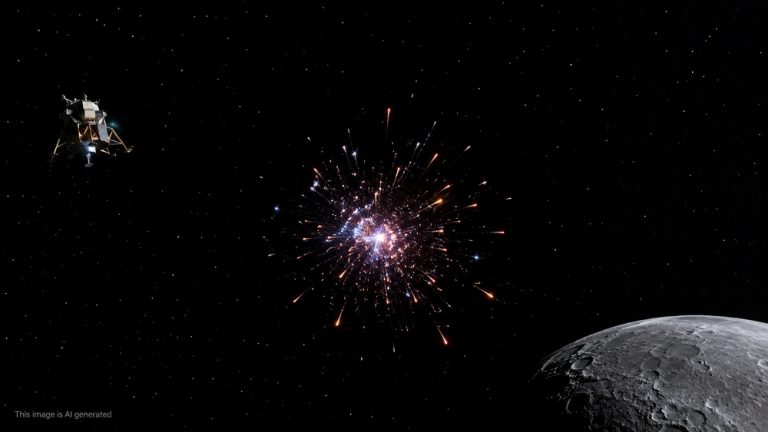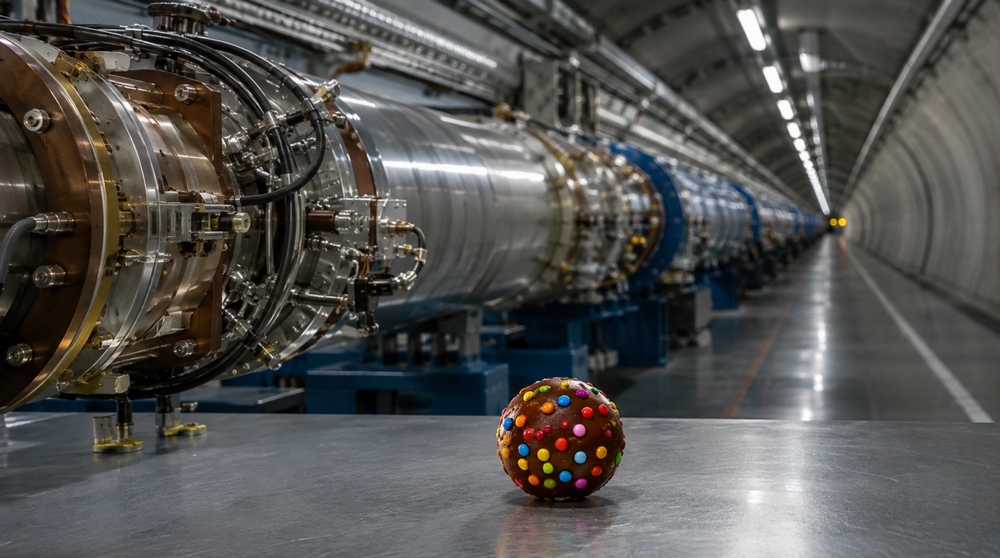
What would happen if a regular chocolate candy were launched inside a massive particle accelerator? At first glance, the idea sounds like science fiction. However, it raises an intriguing question about the enormous energies involved in modern particle physics. While a theoretical scenario suggests that an object traveling at nearly the speed of light could release catastrophic energy upon impact, the reality is very different. As the design of particle accelerators makes such an experiment impossible, the comparison serves only to illustrate the extraordinary scale of these scientific machines.
Particle accelerators are built to propel subatomic particles and atomic nuclei to velocities approaching the speed of light. In theory, if an ordinary chocolate candy could somehow reach a similar speed, the energy released when striking a solid object would be immense.
Furthermore, the impact energy would be comparable to dozens of times the yield of a well-known nuclear weapon used during the second World War. This comparison highlights the enormous kinetic energy associated with relativistic speeds rather than suggesting any realistic possibility.
For readers interested in how particle accelerators work, resources from CERN and educational institutions provide additional scientific background:
Why the Scenario Cannot Happen
Particle Accelerators Are Designed for Tiny Particles
Despite the dramatic theoretical comparison, this scenario cannot occur in reality.
Particle accelerators are specifically engineered to accelerate only subatomic particles and atomic nuclei. Consequently, a chocolate candy cannot be inserted into the accelerator and brought anywhere near relativistic speeds.
The Mass Difference Is the Main Limitation
The fundamental obstacle is mass.
A typical chocolate candy has a mass vastly greater than the particles these facilities are designed to accelerate. Even under the purely hypothetical assumption that its electric charge could be distributed uniformly so it could interact with the accelerator’s electromagnetic fields, the maximum achievable speed would remain extremely low—only a few centimeters per hour. Therefore, reaching anything close to the speed of light is physically unattainable under the described conditions.
Understanding the Scientific Comparison
The example is intended to demonstrate the extraordinary energies involved in particle physics rather than to describe a feasible experiment.
Instead, it illustrates the difference between accelerating microscopic particles and attempting to accelerate everyday objects. As a result, the comparison emphasizes the capabilities of modern accelerators while confirming that the imagined scenario remains impossible in practice. Furthermore, it provides an accessible way to appreciate the scale of energy involved without implying any real-world risk. Nevertheless, the engineering limitations make such an event unattainable.
What To Know In Brief
- Particle accelerators accelerate only subatomic particles and atomic nuclei.
- A theoretical light-speed chocolate candy would release enormous impact energy.
- The comparison is purely illustrative and not physically achievable.
- A chocolate candy is far too massive for existing accelerator technology.
- Even under hypothetical conditions, it would move only a few centimeters per hour.
FAQ
What would happen if a chocolate candy reached the speed of light?
The impact would theoretically release energy comparable to dozens of times that of a nuclear weapon, although the situation is impossible in reality.
Can particle accelerators accelerate everyday objects?
No. They are designed exclusively for subatomic particles and atomic nuclei.
Why can’t a chocolate candy be accelerated?
Its mass is enormously greater than that of the particles for which the accelerator is designed.
How fast could a chocolate candy move in this hypothetical case?
Even under unrealistic assumptions, its speed would be only a few centimeters per hour.
Is this a real experiment?
No. The scenario is presented purely as a theoretical illustration.
Conclusion
The hypothetical idea of launching a chocolate candy inside a particle accelerator is an effective way to illustrate the extraordinary energies associated with modern particle physics. However, the same scientific principles that make accelerators so powerful also make this scenario impossible. Because these facilities are built exclusively for subatomic particles, an everyday object such as a chocolate candy could never approach relativistic speeds.