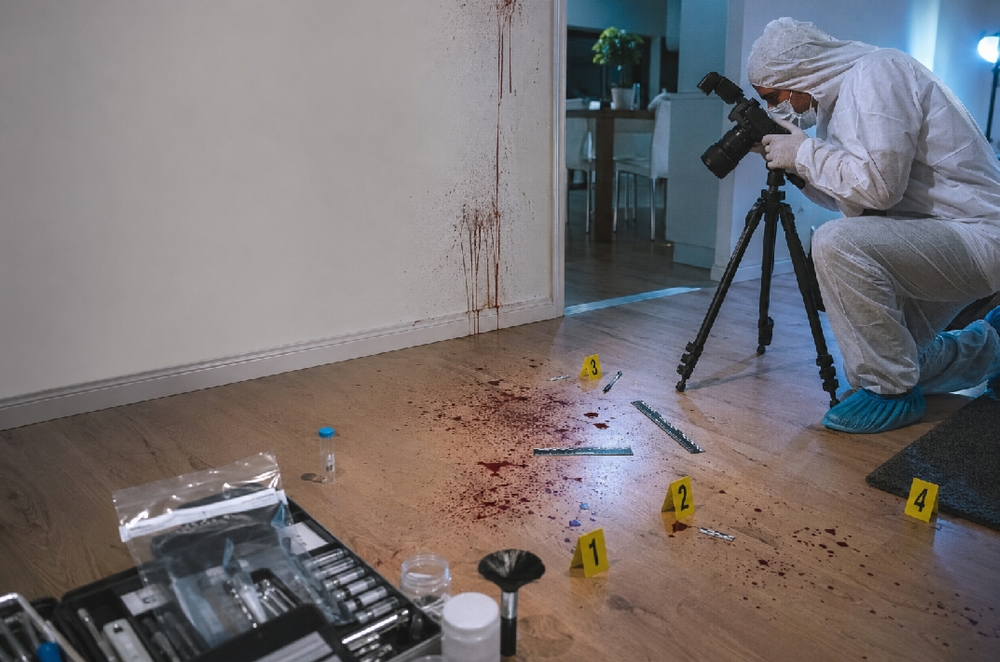
Bloodstain Pattern Analysis is one of the well-known methods used in modern forensic work. Even though a crime scene might look very messy at first investigators look closely at where the blood’s what shape it is and how it is spread out. This helps them figure out what happened during the event. Of depending on just one piece of evidence experts look at blood samples along with fingerprints, biological material what witnesses say, what the autopsy shows and other types of physical clues. According to the information provided this way of working brings together areas like biology, physics and math. It also makes clear that understanding bloodstains is a tool, for investigation but not a perfect way to prove something.
Bloodstain Pattern Analysis is very important in science. It helps investigators figure out what happened at a crime scene. They do not just look at DNA to identify people. Bloodstain Pattern Analysis looks at the characteristics of bloodstains. This helps them make guesses, about what happened and who was involved. They also try to understand how people got hurt. The things they find out from Bloodstain Pattern Analysis are always looked at with evidence. They do not look at these findings by themselves. They use Bloodstain Pattern Analysis and other evidence together.
What Bloodstain Pattern Analysis Can Reveal
Bloodstain Pattern Analysis helps investigators examine several aspects of an incident.
First, the position of blood and its state of drying can assist in determining where an event occurred and the probable sequence of events. Next, biological examinations can associate blood with an individual, estimate how many people were involved, and evaluate their relative positions during the incident. In addition, the appearance of bloodstains may provide clues about the type of injury, the force involved, the possible weapon used, and the direction or height of the impact. Finally, investigators compare blood evidence with witness testimony, autopsy results, and other collected evidence to assess whether different pieces of information support or contradict each other. Therefore, BPA contributes to the overall reconstruction rather than serving as a standalone conclusion.
Understanding Different Bloodstain Patterns
There are several common categories of bloodstain patterns observed during forensic investigations.
Low-velocity impacts usually produce relatively large, circular drops created primarily by gravity. By contrast, medium-velocity impacts are commonly associated with punches, blunt-force strikes, or other violent impacts, generating droplets of intermediate size. High-velocity impacts create numerous microscopic droplets that appear as a fine mist.
Investigators may also examine blood expelled from the respiratory tract, radial patterns produced when an object strikes an already bloodied surface, transfer stains left through direct contact, footwear or object impressions, and “void patterns” where an object blocks blood spatter. Moreover, by studying the direction of individual droplets, analysts can estimate the area from which the blood originated. Chemical reagents may also reveal blood traces that are not immediately visible, while careful photography preserves the original condition of the scene before evidence collection begins.
Scientific Value and Current Limitations
Bloodstain Pattern Analysis has come a way since the late nineteenth century when researchers started creating mathematical models and scientific methods to understand blood evidence. Now it is still a recognized method that is used in criminal investigations.
However, Bloodstain Pattern Analysis is not seen as perfect by everyone. Some situations can be understood in ways and in the past court cases have doubted the trustworthiness of some of the analyses. Also scientific groups have pointed out that the standards for methods need to be more strict. Because of this investigators usually look at bloodstain interpretation along with fingerprints DNA evidence, biological traces, physical evidence, witness statements and other clues, before making a decision.
What To Know In Brief
- Bloodstain Pattern Analysis is a way to figure out what happened at a crime scene by using biology and physics and math to look at blood evidence.
- Bloodstains can really help us understand what happened like what order things occurred in what kind of injuries people got and where everyone was standing.
- There are different kinds of bloodstain patterns and each one happens because of something different.
- When investigators are trying to solve a crime they look at the blood evidence along with fingerprints and other things like that. What people who saw it happen have to say.
- Bloodstain Pattern Analysis is used a lot. It is not perfect and Bloodstain Pattern Analysis is not as good, as using DNA or fingerprints to identify someone.
FAQ
1. What is Bloodstain Pattern Analysis?
Bloodstain Pattern Analysis (BPA) is a forensic technique that examines the size, shape, location, and distribution of bloodstains to help investigators reconstruct how an incident may have occurred. The method combines principles from biology, physics, and mathematics and is used alongside other forensic evidence.
2. What information can bloodstains reveal?
Bloodstains may help investigators determine the location of an event, the probable sequence of events, the number of people involved, their relative positions, and characteristics of the injuries, such as the force applied or the possible weapon used.
3. Are all bloodstain patterns the same?
No. There are several types of bloodstain patterns, including low, medium, and high velocity impact stains, transfer stains, void patterns, radial patterns, impressions, and blood projected from the respiratory tract. Each pattern provides different clues during forensic reconstruction.
4. Is Bloodstain Pattern Analysis considered definitive evidence?
No. Bloodstain Pattern Analysis is an important investigative tool, but it is not considered infallible. Some interpretations may differ, and investigators compare BPA findings with DNA evidence, fingerprints, witness testimony, autopsy results, and other forensic evidence before reaching conclusions.
5. Why is blood evidence photographed before collection?
Investigators document the entire crime scene before collecting evidence to preserve the original position and distribution of bloodstains. This photographic record supports later forensic analysis and helps maintain the integrity of the investigation.
Conclusion
Bloodstain Pattern Analysis is one of the useful tools that forensic investigators have to help understand what happened at a crime scene. By looking at the way blood is spread and comparing it with evidence like biological samples, fingerprints what people say and other physical clues investigators can create ideas about what took place. At the time the field knows that it has limits. Because of this bloodstain analysis should always be looked at along, with all the evidence. This shows how important it is to use different areas of knowledge when solving crimes today.



1 thought on “Bloodstain Pattern Analysis: How Blood Evidence Helps Reconstruct Crime Scenes”
Comments are closed.