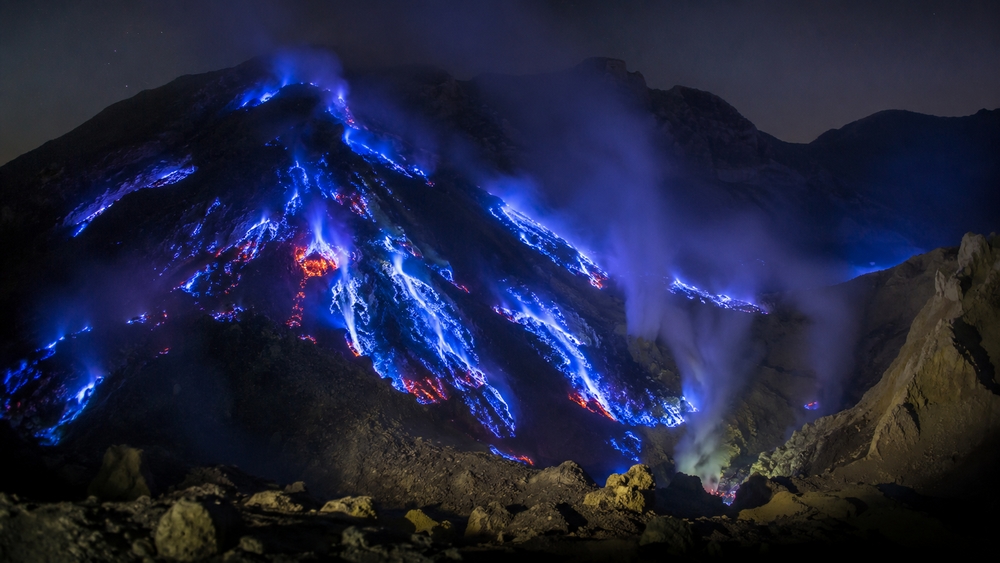
The spectacular images associated with blue lava capture one of nature’s most unusual optical effects. While they resemble streams of glowing blue molten rock, the real explanation lies in volcanic chemistry rather than in the lava itself.
What Is Blue Lava?
Despite its popular name, blue lava is not molten rock that has turned blue.
Instead, the effect occurs when sulfur-rich gases escape from numerous volcanic fumaroles at temperatures that can reach approximately 600°C (1,112°F). As these hot gases come into contact with oxygen in the atmosphere, they ignite, producing brilliant blue flames.
In addition, some sulfur vapor also condenses into liquid sulfur, which continues burning as it flows down the volcanic slopes. This burning sulfur creates the illusion of blue rivers, while the actual lava beneath retains its familiar red-orange color typical of volcanic eruptions.
Read more: National Geographic – Stunning Electric Blue Flames Erupt From Volcanoes
Why Do the Flames Appear Blue?
The blue color is explained by a physical process known as electronic excitation.
During the combustion of sulfur gases, high temperatures provide energy to electrons within sulfur atoms, pushing them into higher energy states. However, this condition is unstable. Consequently, the electrons quickly return to their original state, releasing energy as visible light.
Moreover, every chemical element emits characteristic wavelengths during this process. In the case of sulfur, the emitted light falls within a blue-violet range, giving the flames their distinctive appearance.
Read more: Smithsonian Magazine – This Indonesian Volcano Produces “Electric Blue” Streams of Molten Sulfur
Why Is the Effect Visible Only at Night?
The sulfur combustion occurs continuously throughout the day.
Nevertheless, daylight overwhelms the relatively faint blue light. For this reason, the flames become much more visible after sunset. As a result, the phenomenon appears significantly more dramatic to observers and photographers.
Is Blue Lava Found in Only One Place?
Although this natural phenomenon is often associated with a single famous volcano on a large Asian island, it is not unique to one location.
In fact, the same process has been observed in another volcanic region elsewhere in the world. Even so, the exceptionally high concentration of sulfur and sulfur gases at the better-known site makes it one of the rare places where these blue flames can be be seen with remarkable consistency.
What To Know In Brief
- Blue lava is not blue molten rock.
- The blue color comes from burning sulfur-rich gases.
- Sulfur gases ignite after mixing with oxygen in the air.
- Burning liquid sulfur can create the appearance of flowing blue rivers.
- The phenomenon is most visible at night because darkness enhances the blue flames
FAQ
No. The blue color comes from burning sulfur gases, while the lava itself remains red-orange.
It is caused by the combustion of sulfur-rich gases released through volcanic fumaroles.
Burning sulfur emits blue-violet light due to electronic excitation within sulfur atoms.
The combustion continues during daylight, but the blue flames become much more visible at night.
No. Similar sulfur combustion has been observed in another volcanic area, although one location is particularly well known because of its unusually high sulfur concentration.
Conclusion
Blue lava is one of the most captivating natural phenomena captured in volcanic photography, yet its name is misleading. Rather than being blue molten rock, the spectacular glow comes from burning sulfur gases and liquid sulfur. Ultimately, understanding the science behind the effect reveals how chemistry and physics combine to create one of Earth’s most remarkable nighttime displays.


1 thought on “Blue Lava Explained: The Science Behind the Phenomenon”
Comments are closed.