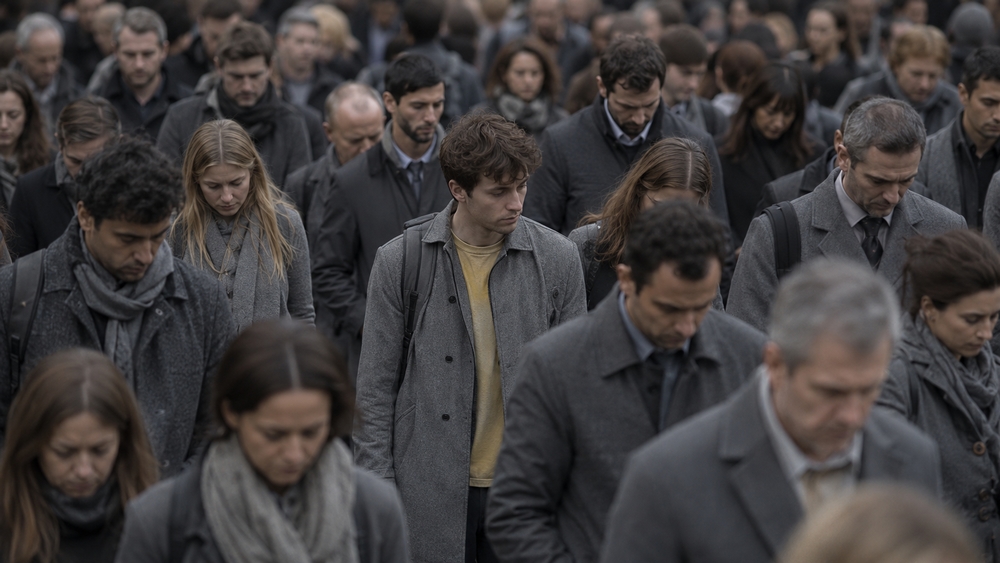
Social conformity can appear harmless. A friend praises an unattractive tie, agrees with a negative opinion about a film and then supports the opposite view minutes later. However, behind this constant agreement may lie a deeper inability, or unwillingness, to express an independent judgment.
People who repeatedly adapt their opinions to those around them are sometimes compared to chameleons. Unlike the animal, however, they do not change colour to survive. Instead, they change their position to avoid conflict, rejection or isolation.
What Is Social Conformity?
Social conformity occurs when people adjust their attitudes, opinions or behaviour to match those of a group.
In everyday life, this tendency can be difficult to detect. For example, a person may wait for someone else to comment on a book, a film or a mutual acquaintance. Only then do they express a view. Moreover, they may strengthen the first opinion they hear, presenting it as an unquestionable truth.
Yet, when another person later argues the opposite, they may abandon their previous position without hesitation. This constant reversal is not necessarily motivated by malice or personal advantage. Instead, it may reflect a powerful desire to remain on good terms with everyone.
Why People Change Their Opinions
People who constantly agree with others are often peaceful, polite and insecure. Above all, they want to belong. Contradicting someone creates discomfort, while defending an unpopular position can feel unbearable.
Research literature describes conformity as part of the broader field of social influence. Researchers also distinguish between informational influence and the pressure to gain social acceptance, as explained in this review of conformity mechanisms.
Consequently, the greatest difficulty arises when two people demand support for incompatible positions. The conformist may change the subject, search for an artificial compromise or offer a sufficiently vague answer.
This indecision recalls Buridan’s ass, the philosophical example of an animal unable to choose between two equivalent alternatives.
When Social Conformity Becomes Dangerous
An isolated people-pleaser may cause little harm. However, the consequences become more serious when large numbers of people stop exercising independent judgment.
In public life, social conformity can turn into opportunism. Individuals may follow the dominant group because it offers protection and reduces personal exposure. Therefore, their loyalty lasts only until the balance of power changes.
Studies of the neuroscience of social conformity examine how other people’s opinions can influence attitudes and decisions. Similarly, research into the collective dynamics of opinion explores how social interaction can spread beliefs and shape group behaviour.
What To Know In Brief
- Social conformity means adapting opinions or behaviour to a group.
- Constant agreement may conceal insecurity and fear of rejection.
- Conformists often wait for others before expressing a judgment.
- The behaviour becomes dangerous when it affects entire communities.
- Independent thinking requires the courage to disagree respectfully.
FAQ
What is social conformity?
Social conformity is the tendency to adjust opinions, attitudes or behaviour to match the expectations of another person or group.
Why do some people always agree with others?
They may fear conflict, rejection or isolation. Agreement allows them to feel accepted and protected.
Is conformity always intentional?
No. Some people conform automatically and may not recognise how frequently they change their position.
Can social conformity be dangerous?
Yes. It can weaken critical thinking and make groups more willing to support dominant authorities without questioning them.
How can people resist social conformity?
They can pause before agreeing, examine their own judgment and learn to express disagreement calmly and respectfully.
Conclusion
Social harmony does not require abandoning personal judgment. Although compromise is often valuable, constantly changing opinions to please others carries a cost. A healthy society depends not only on cooperation but also on people who are prepared to question, disagree and speak in their own voice.